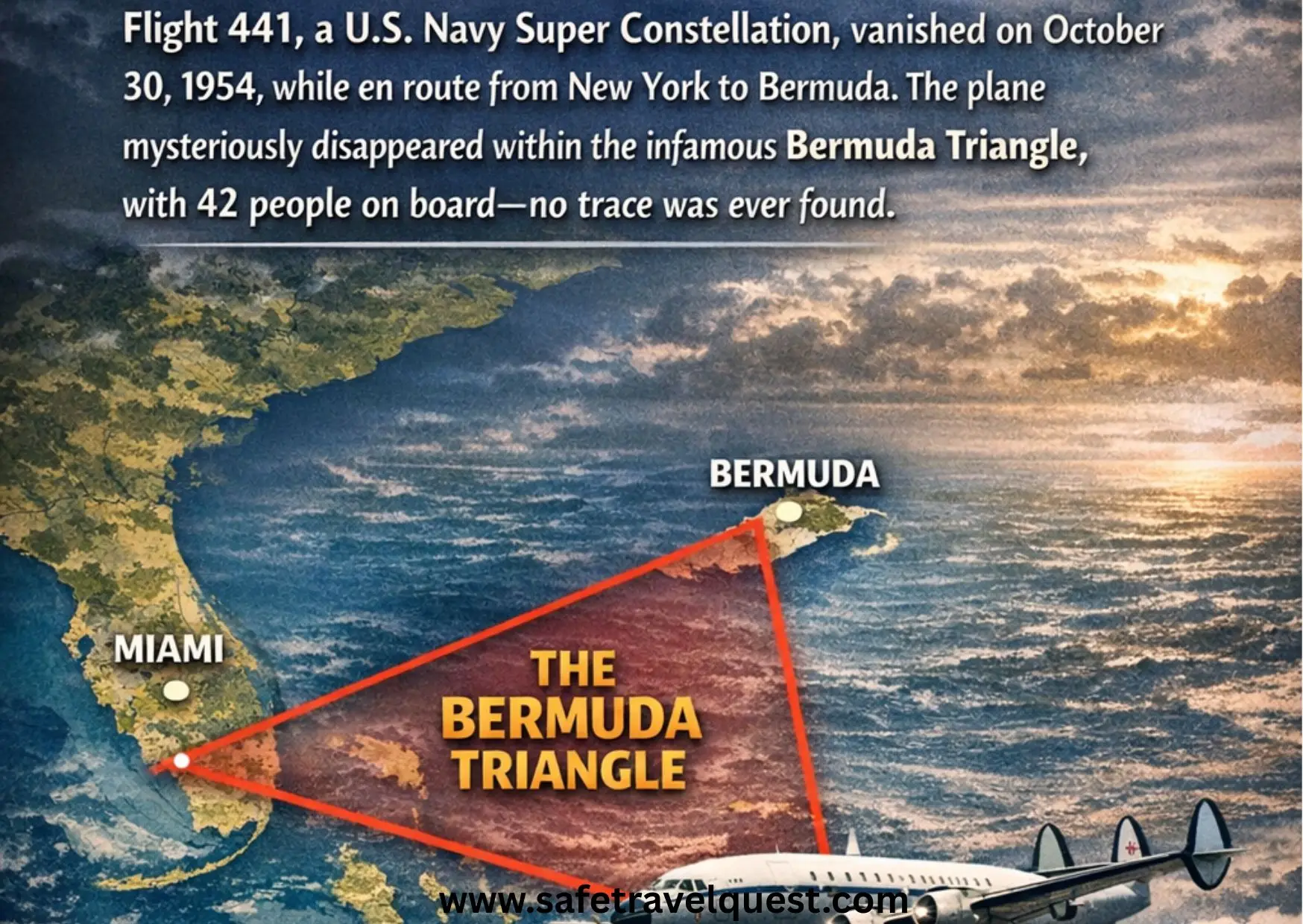
Flight 441 is the name of a United States Navy Lockheed R7V-1 Super Constellation that vanished on October 30, 1954, as it flew a military transport flight on a route across the Atlantic Ocean. The plane, which had 42 passengers and crew, disappeared around 400 miles of the coastline of Maryland that is commonly geographically linked with the mythical Bermuda Triangle.
Although the disappearance of the flight was one of the reasons behind the interest toward the region in the mid-20th century, the current aviation studies and official inquiries reveal a more practical approach to the event. This paper covers the actual history of Flight 441, the reality of flying through the Bermuda Triangle today, and why this particular route of traveling stands as such a subject of high interest to not only the experts in the field of aviation history but also the curious traveler.
What Was Flight 441?
Flight 441 was a military transport flight that was run by the U.S. Navy. It was a Lockheed R7V-1 Super Constellation, which was a four-engine propelled aircraft that was fast and reliable in the 1950s. It was regarded as one of the most modern transport aircrafts in the Navy then.
It took off in Patuxent River Naval Air Station, Maryland, and was supposed to land in Lajes, Azores, Portugal. It was supposed to go on to Port Lyautey in Morocco. The plane had on board 21 crews and 21 passengers which included military personnel and their families. However, even though the plane was well-built, and the crew had extensive experience, the plane never arrived at the destination, which became one of the biggest air catastrophes in naval history.
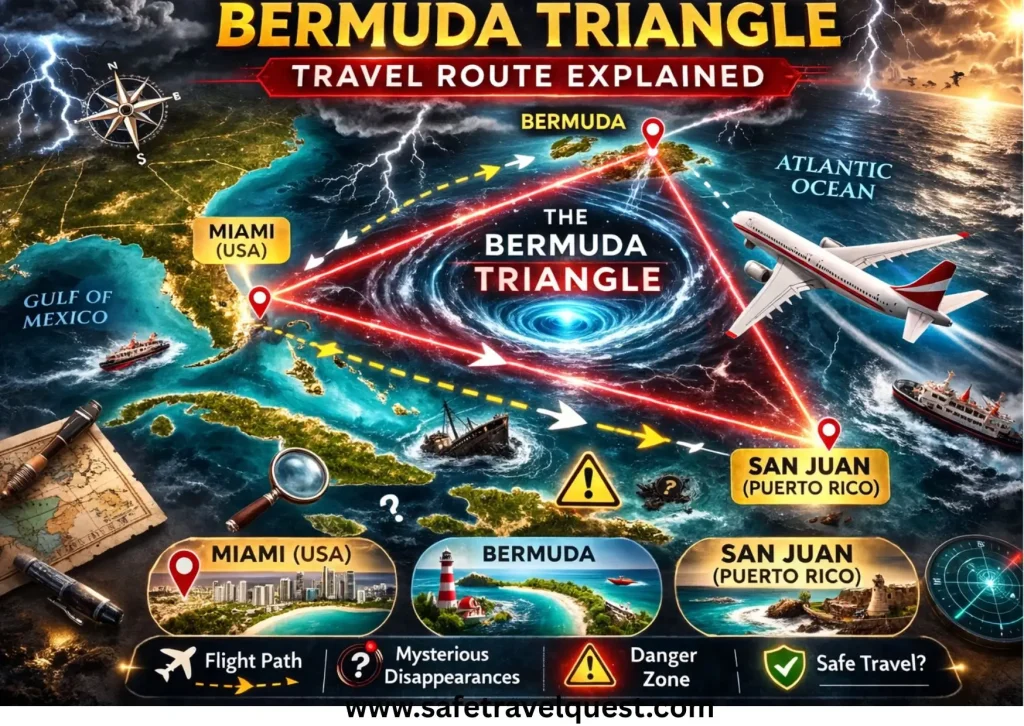
The Bermuda Triangle Travel Route explained.
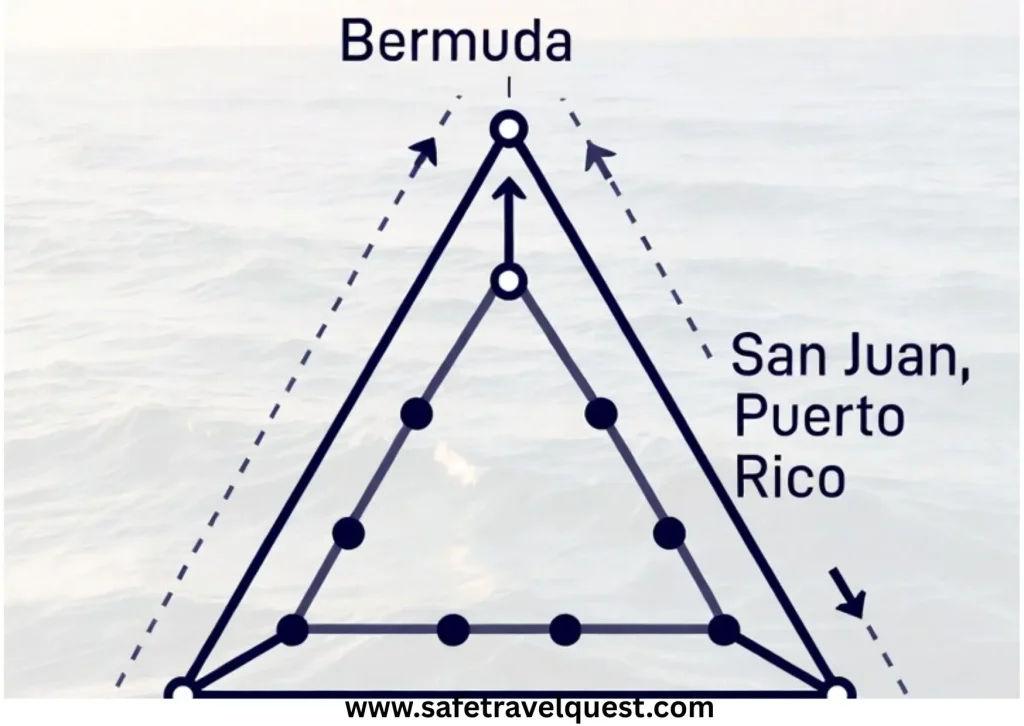
The Bermuda Triangle is an unofficially approved area in the western section of the North Atlantic Ocean. Geographically, it is generally bordering Miami, Bermuda and San Juan, Puerto Rico. This territory also lay within the path of Flight 441 as it was flying along the route of the Maryland coast to the Azores.
This area has been traditionally one of the busiest shipping and aviation routes in the world. It is a major connection between the Caribbean, Europe and the Americas. The rate of incidents that occurred in that place was proportional to the large number of traffic that used to pass through the century. Nevertheless, Bermuda Triangle is the name that did not receive a popularizing effect until the 1960s, decades after the flight 441 vanished.
What Happened to Flight 441?
Flight 441 took off on the night of October 30, 1954 on the Patuxent River. At about 11.30 PM, the crew had a regular radio contact where they said they were about 400 miles east of Baltimore. It was said to be generally fair, but seasonal Atlantic storms could always happen.
After that delivery, the plane disappeared. The wreckage and the 42 occupants had never been found and after a large-scale search and rescue mission that used ships and planes, no sign of any distress had been identified. The official Board of Inquiry of the Navy determined that the aircraft must have encountered a sudden and violent force that made the aircraft uncontrollable although the nature of the force was not clearly known.
Did Flight 441 Have anything to do with the Bermuda Triangle?
Over the years after the incident, sensationalists writers listed Flight 441 among the list of mysterious disappearances in the Bermuda Triangle. They tended to underline the absence of debris and the absence of a distress signal to indicate some supernatural or paranormal reasons.
The reality of environmental influences
Nevertheless, an objective consideration leads to environmental influences. The middle Atlantic is also characterised by sudden weather changes and intense “rogue” storms. Contemporary researchers believe that the Super Constellation might have had to face severe turbulence or abrupt structural breakdowns, which can happen in any high traffic airline route. The number of disappearances in this area is statistically no more high than in any other similar area of the world’s oceans in terms of traffic volume.
You may also like it:
Albany Beach Australia: Guide, Safety, Tips, and Travel Advice
Bran Castle Tours from Brasov: Best Day Trips, Routes & Tips for 2026
What to Expect Visiting Alaska Alaska AJU Tour, Highlights and Travel tips 2026
Travel Hacks cwbiancavoyage: Intelligent, Pulpmastery Travelfore tips to make 2026 Travels Easier.
Aviation Safety on the Bermuda Triangle Region
The Bermuda Triangle is as safe today as any other segment of the international airspace. The airlines such as American, Delta and British Airways fly thousands of times annually through this area with no incidents.
There are a number of contributing reasons to this present safety track record:
- Satellite Navigation: Modern GPS has substituted the magnetic compass as the major tool of navigation, and removed any error of magnetic variations.
- Independent Weather Radar: Pilots are now able to view and maneuver around the extreme storm cells.
- Constant Communication: The contemporary air traffic control (ATC) also keeps in touch with aircraft by constantly communicating with them via satellites and high-frequency radio.
- Engine Reliability: With the switching of the previous 1950s piston engine to jet turbines, the rate of mechanical failures has reduced significantly.
Commonly Holded Myths on the Bermuda Triangle.
The Bermuda Triangle has a lot of cultural fascination that is mostly myths that tend to cover the facts on the ground.
- Myth: Magnetic compasss never turn themselves in. Fact: although the area has magnetic variations, they are well known to navigators and are present in most parts of the world.
- Myth: There are more disappearances here than there. Fact: According to studies conducted by the U.S and the Lloyds of London, the rate of incidents does not proportion to the quantity of traffic.
- Myth: There is a no-fly zone in the region. Fact: It continues to be among the busiest Airways routes where passengers fly between the East Coast of the U.S. and the Caribbean and Europe.
Why Travelers still seek to have flights to the Bermuda Triangle.
The long fascination over the Bermuda Triangle and a flight such as Flight 441 is a result of a human interest in the unknown. To the history lover, the 1950s are the Golden Age of Aviation and the loss of an oversized Super Constellation is a mystery of that time that is richly compelling.
These historical travel paths are still revisited in cultural media such as documentaries and novels. To most passengers, it is a delight to fly over an area which is so reeking with such mythical folklore, despite the fact that modern flight is by far the safest mode of travelling.
The way modern flights fly over the Bermuda Region.
Flight routes of commercial flights across the Bermuda region are tightly controlled and regulated. Pilots use predetermined paths, which are designated as Airways, which are actually highways in the air.
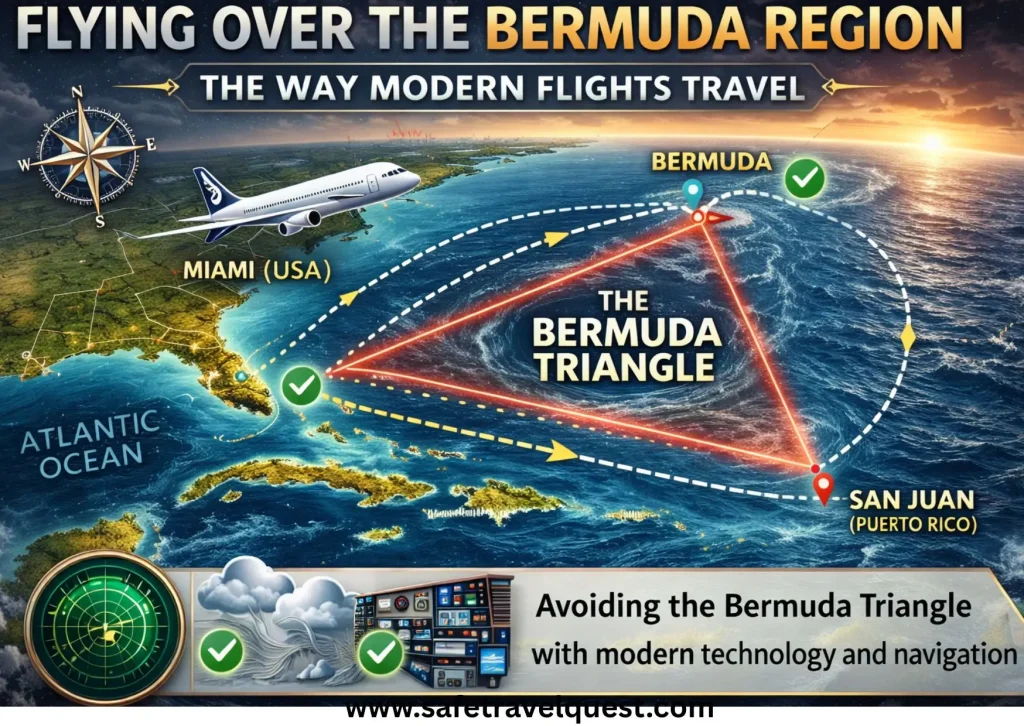
Some of the current aviation safety procedures include:
- Flight Tracking: ATC systems monitor all ADS-B commercial flights.
- Engine Redundancy: ETOPS (Extended-range Twin-engine Operational Performance Standards) is the assurance that nowadays aircrafts are able to safely fly to the airport even in case one of the engines fails during the ocean flight.
- Emergency Beacons: In case of a plane crash, today satellite linked emergency locator transmitters (ELTs) would instantly identify the position and this is a technology that was not present when Flight 441 disappeared in 1954.
Frequently Asked Questions
Did Flight 441 disappear?
Indeed, on October 30, 1954, the U.S Navy Flight 441 disappeared, and there were 42 passengers aboard. Although a thorough search was carried out in the Atlantic there was not a piece of wreck, or debris, or survivor to be discovered. It is still one of the most renowned unsolved military aviation mysteries.
Are there dangers in the Bermuda Triangle to the flights?
Statistically, no. The U.S Navy, the Coast Guard and the international aviation bodies do not recognize the Bermuda Triangle as a dangerous zone. Modern navigation and safety measures can ensure that thousands of commercial and private aircraft fly through the region safely every year.
Do modern planes bypass the Bermuda Triangle?
No, there is nothing that can cause modern airplanes to avoid the Bermuda Triangle. It is one of the busiest flight routes that connect North America, Europe and the Caribbean. On flying between Miami and London or New York and San Juan, you probably will fly directly over it.
What is the actual cause of incidences in that region?
The human errors, failure of equipment, and the environment such as sudden Atlantic storms or the rapidly moving gulf stream current are the major causes of most of the events in the area. Traditionally, it was that deep water of the Puerto Rico Trench and technology of the 1950s had prevented any debris being found.
You may also like it:
Nimbus Cloud Travel Pillow: Guide to In-Flight Comfort 2026
Flight 441 Bermuda Triangle Travel Route: History, Safety and Facts.
Is it Dangerous to Travel to Turkey?
How to Travel on a Plane with Fresh Tattoo
Final Perspective
Flight 441 and the route used to travel through the Bermuda Triangle is an interesting event in the history of aviation. Although there is no resolution to the disappearance, it is a reminder of just how well aviation safety has been in the decades since 1954.
Nowadays, the passengers can travel across the Atlantic without any doubts due to the satellites monitoring, the advanced radar, and international safety regulations. Venturing into these historical paths allows us to recognize the achievements of the current aviation technology which has made what used to be regarded as an unfamiliar and risky voyage to be a known and secured route to everybody.

I am a passionate writer who creates engaging, creative, and meaningful content that informs, inspires, and connects with diverse audiences.