
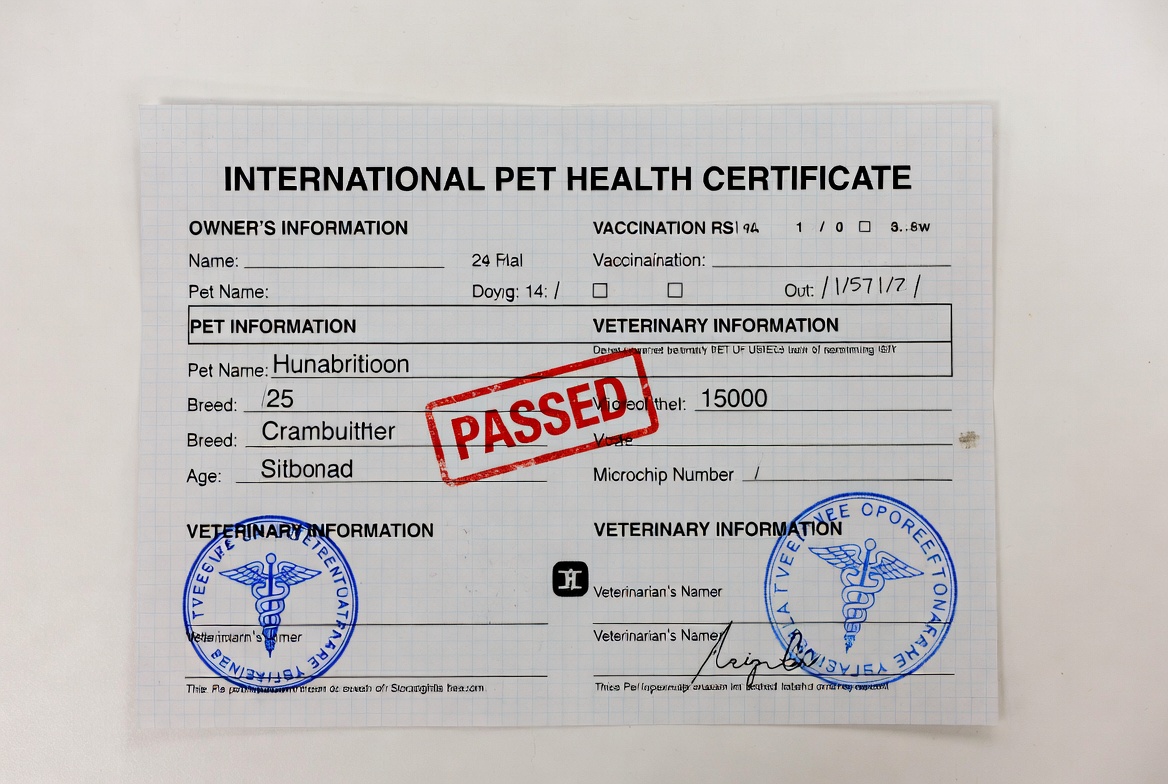
A health certificate for pet travel, also referred to as Certificate of Veterinary Inspection (CVI) is an official document issued by a licensed veterinarian. Health certificate pet travel ascertains that your dog or cat is in good health, free of any infectious diseases, and all vaccines are taken against those required in the country where you are going.
This is a key document in almost all types of pet transportation, as it allows your pet to legally enter any state or even country, as well as avoids the spread of disease to the rest of the animal population.
Travelling with a pet may be a complicated affair since the rules in domestic travel differ greatly in international relocation. The health certificate is that key passport to your pet whether you are transporting it across the country or flying across the ocean. This guide will give you a detailed dissection on how to get this documentation, the important time schedule that you should take care of, and the safety precautions you need to take to get a smooth ride.
What Is Health Certificate Pet Travel?
Fundamentally, a health certificate is a document that is issued by a medical authority. It means that your pet has been physically checked by a professional veterinarian and he or she has established it to be fit to travel. It is not only a demonstration of vaccination, but a photo of your pet’s health at a certain point of time.
The certificate usually consists of:
- Identification of the Pet: Name, breed, age, color, and microchip number.
- Vaccination Records: This is rabies, and other core vaccinations such as distemper or parvovirus.
- Health Status: A statement, which proves that the pet is free of contagious or infectious diseases.
- Travel Details: The origin address and the destination one.
These certificates should be a work of a licensed veterinarian. To travel internationally, the veterinarian has to be frequently USDA-accredited (in the United States) or analogous in your country of origin.
When Do You Need a Health Certificate?
You are supposed to believe you need a health certificate whenever you take your pet out of the area it resides in, but the triggers do not always work in a similar way.
Travel within the United States (Domestic)
The health certificate that pets need to travel with them in the cabin or as cargo is mandatory in most of the major airlines. Although this is never inspected at the side of the road, many states have a legal requirement of a CVI to pass certain state lines, but these are not always enforced. Nevertheless, they are essential in case you intend to reside in hotels or hire professional transport services for pets.
International Travel
It is at this point that requirements are strict. There are house rules in every country. There are ones that only need a simple certificate, and some of the rabies-free destinations such as Japan, Hawaii, Australia, and New Zealand only demand blood tests (titer tests), import permits and in some cases months of preparation.
Time Validity Limits
The health certificates are time-sensitive. A certificate is required to be issued within a period of 10 days of traveling, which is the requirement of most airlines and countries. Your certificate might be rejected as invalid in case you arrive at the check-in counter and you have 11 days left to the certificate and your pet may be refused to be boarded.
There are several types of Pet Travel Health Certificate.
The difficulty of the paper work is based on the borders of your destination.
- Domestic (Interstate) Certificates: These are generally less complex types (such as APHIS Form 7001) that can be completed by your vet in a small fraction of a minute during an exam.
- International Health Certificates: These usually take several pages and certain language needed in the country of destination. In the US, they have to be filed to the USDA to obtain an official endorsement stamp.
- EU Pet Passport vs. Health Certificate: In case you are a resident of the European Union you will use a Pet Passport. But when you are going to the EU (and not to its outside) (such as the U.S. or Canada) then you have to use a special EU Health Certificate which you have been issued in your country of origin.
In order to travel with pets, a health certificate is required.
The process of getting a certificate is not very easy and needs to be well coordinated with your vet.
- Research Your Destination: It is important to go to the official government site of your destination before you book a vet app (e.g. the USDA APHIS Pet Travel portal when leaving the U.S.). This will be the specifics of what kind of vaccines and forms are needed.
- Locate a Certified Veterinarian: Make sure your vet is a certified signature to international documents. This particular certification is not found in all local vets.
- Schedule the Exam: Make your Health Certificate Exam booking in order to book within the necessary timeframe (typically in the ten days leading up to your flight). It is best to carry all the prior vaccination history along with the latest certificate of rabies.
- Government Endorsement (Outside the US only): After your vet has signed the form it may need a second signature by a government official. Your vet will be required to file the paperwork electronically in the U.S. through the **VEHCS (Veterinary Export Health Certificate System). You might have to pay extra on this government stamp.
What is the length of a pet travel health certificate?
The most widespread cause of delays during travel is timing. As a rule, a health certificate is valid within 10-30 days, although regulations are individual:
- Airlines: The majority of them demand the certificate to be issued in the course of 10 days before your flight.
- Entry Requirements: In some countries the certificate must be stamped by the government (endorsed) during 48 hours through 10 days of arrival.
- Return Trips: In case you are travelling on a short trip, ensure that your certificate is valid to cover the return trip. As a case in point, an EU health certificate can usually be used in travel within the EU up to a period of four months as long as the rabies vaccine is not out of date.
There are typical travel requirements of pets.
In addition to the certificate, you will probably have to demonstrate a number of other health achievements:
- Microchip: A microchip of ISO-compliant (15-digit) is required in most international destinations. Important Safety Accommodation: The microchip can and must be implanted along with or prior to the rabies vaccine to be legally considered a valid vaccine.
- Rabies Vaccination: This should be up to date. When your pet has just been given its first rabies vaccination, there are a number of countries that demand that you stay at home with the pet for a period of 21 days before the pet is allowed to travel.
- Tapeworm Treatment: Please note that some countries (such as the UK, Ireland, Finland, Norway, etc.) impose a tapeworm treatment that must be administered by a vet 1-5 days before arrival.
- Rabies Titer Test: In case of the islands which are under control of rabies, a blood test must be done to show that the vaccine is effective. This may require 3 to 6 months to go through.
Safety and Security
On safetravelquest.com we underline the fact that half of the way is in documentation, but the physical safety of your pet is first of all.
Pre-Travel Health Checks
Travel anxiety is an excellent time to speak about a health certificate examination. Although the AVMA (American Veterinary Medical Association) does not favor sedation as it is considered dangerous at high altitudes, your vet might prescribe calming supplements or pheromone sprays.
Stress and Temperature Risk
There are temperature limitations on airlines. And in case it is too hot (above 85°F) or too cold (below 45°F) at any point of the journey- even during the layovers, the airline will deny you the right to carry your pet into the freight cabin because of its safety.
Cabin vs. Cargo
When you have the opportunity, bring your pet in the cabin. When your pet is too large and requires flying as cargo, you have to make sure that he is in an IATA-compliant crate, which is sturdy, well-ventilated, and big enough to allow it to stand up and spin around.
Common errors which owners commit with pets.
- waiting until the last minute: 6 months of preparation could be required on international traveling. Having begun two weeks prior to your flight is the formula to being rejected.
- Any Veterinarian Can Sign: It is always important to make sure that your veterinarian is USDA-qualified in that particular country you are going to.
- The Microchip Sequence: Rabies vaccination before the microchip: this is a popular mistake that calls into question the validity of the vaccine in the mind of most customs officials.
- Disregard of the Layover Rules: In case of a third country layover (such as a stop in London on your way to India), you have to also fulfill the pet entry/transit requirements of the layover country.
Travelling with your pets internationally: TIPS.
These three main resources are used in order to make a successful trip:
- USDA APHIS Website: The platinum standard when it comes to pet travelers residing and driving in the United States.
- Destination Embassy: Check with the visiting country embassy to ensure that there are no recent emergency alterations to the pet laws.
- Airline Pet desk: Do not visit the airline site, simply call the Pet Desk number and confirm that you are booked and they have specifically set deadlines on paperwork.
Frequently Asked Questions
What is the price of a health certificate?
Prices differ depending on the complexity of clinics and destinations. Domestic certificates can range between 75 and 200. The paperwork required to issue the international certificates is higher making the certificates to cost between $250 to $600 plus the additional costs of having the certificates endorsed by the government.
Can I travel to the domestic area with a health certificate?
Almost definitely, as you are flying. Most airlines such as Delta, American and United offer pets in cargo to be provided with a health certificate not more than 10 days to the flight date and most will also have pets in the cabin that require a health certificate. Look at the policy of your particular airline.
When would I have to get the certificate before traveling?
In the case of the majority of airlines and countries, the examination should be conducted within a time span of 10 days of the day of departure. You must however begin the process of preparation (vaccines and microchipping) at least 30 to 60 days prior to visitation of simple locations and 6 months prior to visitation of complex locations.
Is there any difference between a health certificate and a pet passport?
No. This is a lifelong document called a pet passport and is mostly used by residents of the EU when travelling inside Europe. A health certificate is a single time document applicable to a particular trip, normally needed to enter a country in an external region.
Final Travel Advice
The most effective method is to prepare in order to be safe with your pet and to be calm. The health certificate to travel with a pet is not a piece of paper, but a crucial document to prevent the spread of the disease worldwide and which is physically oriented to the endurance of the transit by your pet. You should have all documents, both hard copies and soft copies of all documents, and always begin your research early, communicate effectively with an accredited veterinarian and do all this. With the help of official government and airline regulations, you will be able to concentrate on the trip you will make, and not the tension at the border.
SEO Title:.
Meta Description:

I am a passionate writer who creates engaging, creative, and meaningful content that informs, inspires, and connects with diverse audiences.