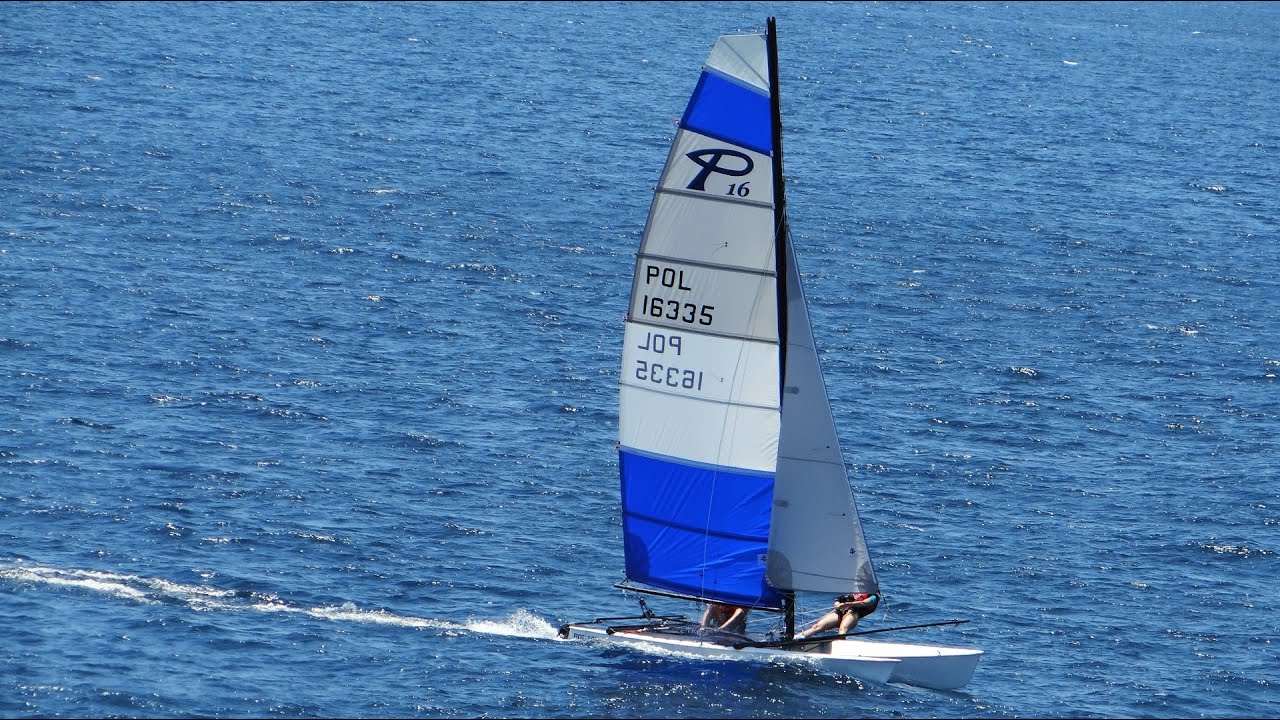
The Prindle 16 Traveller is a vintage performance catamaran sailboat that was invented by Geoffrey Prindle in the early 1970s. It is a 16 foot beach cat, which is extensively known due to its asymmetric hull design as well as its fame as a stable, fast and forgiving boat used by recreational and club sailors.
This paper will take a closer examination of Prindle 16 Traveller, including its technical performance, handling features, and its safety requirements. Hit or miss: As a more experienced sailor seeking a nostalgia-tinged project or an amateur sailor seeking the technical and practical background on one of the sturdiest and longest-lasting beach cats, this guide offers the experience and understanding you need to gain on sailing.
What is the Prindle 16 Traveller?
The Prindle 16 is a twin hull cat that was originally constructed by Surfglas, then by Lear Siegler and Nacra. It was launched in 1971 and was meant to provide competition to the Hobie 16 but it had a different hull geometry and a different sail plan. The term Traveller designation is generally known as the adjustable traveler system to manage the position of the mainsail across the rear beam, which will enable easier sail trimming in various wind conditions.
In contrast to most of the modern performance cats, which control sideways drift with the help of daggerboards, the Prindle 16 offers the use of asymmetric hulls. This design consists of a flat inboard surface and a curved outboard surface which forms a hydrodynamic form that does not provide lift or tracking, unlike other boards that have very complex mechanical systems. This renders it a perfect boat that is to be launched on the beach and sailing in shallow waters since there is no underwater appendage to retract and create damages.
Major Peculiarities of the Prindle 16 Traveller.
Technical accuracy plays an important role in determining the capabilities of sail boat. The Prindle 16 was designed with the capacity to be lightweight so that it can be handled on the beach but heavy enough to accommodate two people on board in themedian surf.
- Length Overall (LOA): 16.0 feet (4.88 meters)
- Beam (Width): 7 feet 11 inch (2.41 meters)
- Weight: Approximately 300 lbs (136 kg)
- Draft (Rudders up): 7 inches (0.18 meters).
- Draft (Rudders down): 1 ft. 10 in. (0.56 meters).
- Mainsail Area: 142 sq ft (13.19 sq m)
- Jib Area: 48 sq ft (4.46 sq m)
- Total Sail Area: 190 sq ft (17.65 sq m)
- Hull Material: Fiberglass (GRP).
- Crew Capacity: 1-2 adults (Class racing is usually double handed)
Performance and Handling
The Prindle 16 has been noted to have a lively feeling. Due to its asymmetric hulls, it sails better upwind and is less prone to the nosediving (pitchpoling) problems that will afflict the rest of the early beach catamarans.
Speed and Stability
The Prindle 16 has high speeds that can be reached in just 10- 12 knots of wind due to its 190 square feet of sail. The hulls are also larger in the bows than the Hobie 16 and this helps it to be more buoyant when it reaches in heavy air. The extra volume is what makes the boat more forgiving and stable to those recreational sailors who might not have an ideal weight distribution.
Skill Level Required
The sail is available to the intermediate sailor and has just technical depth enough to make it enjoyable to the experts. Tuning can be highly utilized in the rotating mast and fractional sloop rig. Although the novice can be taught to handle the fundamentals on a Prindle 16 in very light air, the boat is so slow and the physical effort of trapezing that it is a good idea to have the experience of working with smaller dinghys or multihulls before attempting to drive the boat in stronger winds.
Safety Considerations
Cruising a small catamaran is associated with the inherent risks, which are mainly associated with capsize and high-speed moves. Safety equipment and preparation is not a discussion issue in marine activities as it is stated on the safetravelquest.com.
Capsizing Risk and Recovery
The Prindle 16 being a beach cat, like all beach cats, may be upset in case it is pushed too strenuously or a puff of air gets hold of the sails and carries them away before they are uncleated. The boat is 300 lbs, and hence it needs proper technique to be righted.
- There is no sailing without a special righting line on the main crossbeam.
- Procedure: The procedure involves bending backwards over the lower section of the boat, holding the righting line in order to pull the mast out of the water, with the use of body weight to straighten the boat. Two people are normally needed in light winds and in strong winds, the wind on the underside of the sail may help the process.
Essential Equipment
- PFDs: The use of Personal Flotation Devices is mandatory among the members of the crew.
- Trapeze Harness: When sailing in high winds, a harness enables the crew to stand on the edge of the hull so that they can provide counter-balance.
- Mast Float: It might be a good idea to have a mast-head float so that the boat does not turtle (turns completely upside down).
Prindle 16 Traveller
The prindle 16 is a flexible boat that suits multiple niches in the sailing world.
- Recreational Sailors: It is a perfect option with a person wishing to take off on a beach and spend the afternoon on the water. It is totally user-friendly as it does not have daggerboards.
- Solo Sailors: Solo sailing was intended for two, however, a skilled sailor can sail a Prindle 16 in light to moderate winds, but it is tough to right the boat by yourself, after a capsize.
- Families: The mesh trampoline gives a more secure base to two or a parent and child. Nevertheless, it is a performance boat; it is not a lounge boat and cannot be operated passively by the crew.
There are several issues regarding maintenance and ownership that need to be considered.
To own a classic Prindle 16 one has to devote themselves to fiberglass maintenance and rigging inspection. As these boats are not currently in active mass manufacture, the parts are frequently obtained via custom retailers or the used market.
Hull Maintenance
Look at the hulls frequently in order to detect soft spots, meaning delamination (the fiberglass pulling off the foam core). The gelcoat cracks that are small should be sealed to avoid the entry of water. It is always best to empty the hulls through the transom plugs and keep the boat without the plugs in case the pressure needs to be evened out.
Rigging and Sails
Check the stainless steel standing rigging (shrouds and forestay) on whether it has meat hooks or frayed. When the wires are old and possibly dating to the 1970s or 80s then they must be replaced as soon as possible to prevent future accidents. Fresh water ought to be used in rinsing of sails and drying them to avoid mildew and salt decay before long term storage.
Prindle 16 Traveller v. Like Catamarans.
The most popular one is that of the Prindle 16 and the Hobie 16.
| Feature | Prindle 16 | Hobie 16 |
| Hull Design | Asymmetric, high-volume bows | Asymmetric, banana shape |
| Trampoline | Flush with hulls | Raised on pylons. |
| Daggerboards | None | None |
| Pitchpole Risk | Lower (More buoyancy forward) | Higher |
| Parts Availability | [Not specified] | Good (Still in production) |
Although the Hobie 16 is more famous and has higher following in the racing community, the Prindle 16 is more common among the sailors due to the fact that it has a smoother ride and better ergonomic trampoline design.
My purchase of a Used Prindle 16 Traveller.
The Prindle 16s currently available in the market are old-fashioned; most of them are over 40 years old. During the inspection of a used boat, structural integrity should be given more weight than aesthetics.
- The Tap Test: Tap the hulls with a coin. A nice crackle is a good one, but a muted bang would indicate delamination or wet foam.
- Mast and Crossbeams: Examine the aluminum closely to check it against serious corrosion, particularly in those areas where the fittings with stainless steel are riveted to the aluminum.
- Rudder System: Make sure the kick-up system is in good operation. Prindle rudders are reputed to be very strong, although the castings may crack with time.
- Price: This is because a boat with crisp sails and a fresh rigging will cost more. The price of a new sail and wires can soon surpass the price of a boat, and a project boat in a yard may be cheap.
Frequently Asked Questions
Coming to the question of whether the Prindle 16 Traveller is beginner friendly or not, one must acknowledge that it is an ideal product and the model that every beginner would prefer to operate.
The Prindle 16 is a nice boat that can be used by novice sailors who have some basic knowledge of sailing. It is not as demanding as most high-performance catamarans since it is not fitted with daggerboards and its hulls are buoyant and do not nosedive. Nevertheless, the practice of capsize recovery must always be done under controlled conditions by the beginners.
How fast can a Prindle 16 go?
With optimum conditions (15-20 knots wind) then a Prindle 16 is capable of 18-22 knots. It reaches its maximum speeds on a wide reach, as do most of the beach cats, and the crew is on the trapeze.
Can it handle rough water?
The Prindle 16 was planned as a beach cat, i.e. it can deal with ocean swells and surf. Its large-volume hulls enable it to ride the waves instead of crushing them, which makes it a better sea boat than other smaller or narrower catamarans.
Final Advice
The Prindle 16 Traveller is also popular with multihull fans because of its simplicity and straight forward performance. The Prindle 16 is among the best boats in the market should you need a boat which is easy to launch, fast in the water and to which the mechanical operation is simple.
Most of the available units are pristine, but since the majority of them are of vintage nature, it is necessary to carry out extensive pre-sail checks. Make sure that your standing rigging is in good condition and make sure that your safety equipment is up to date. When maintained and with respect to the wind, the Prindle 16 is pure and exciting sailing unlike many other modern boats at the same price.
SEO Title:
Meta Description: The Prindle 16 Traveller? Research. Learn technical features, tips to use it, safety precautions, and the performance of this old fashioned catamaran against the Hobie 16.

I am a passionate writer who creates engaging, creative, and meaningful content that informs, inspires, and connects with diverse audiences.